Tens of thousands join Independence March in Warsaw
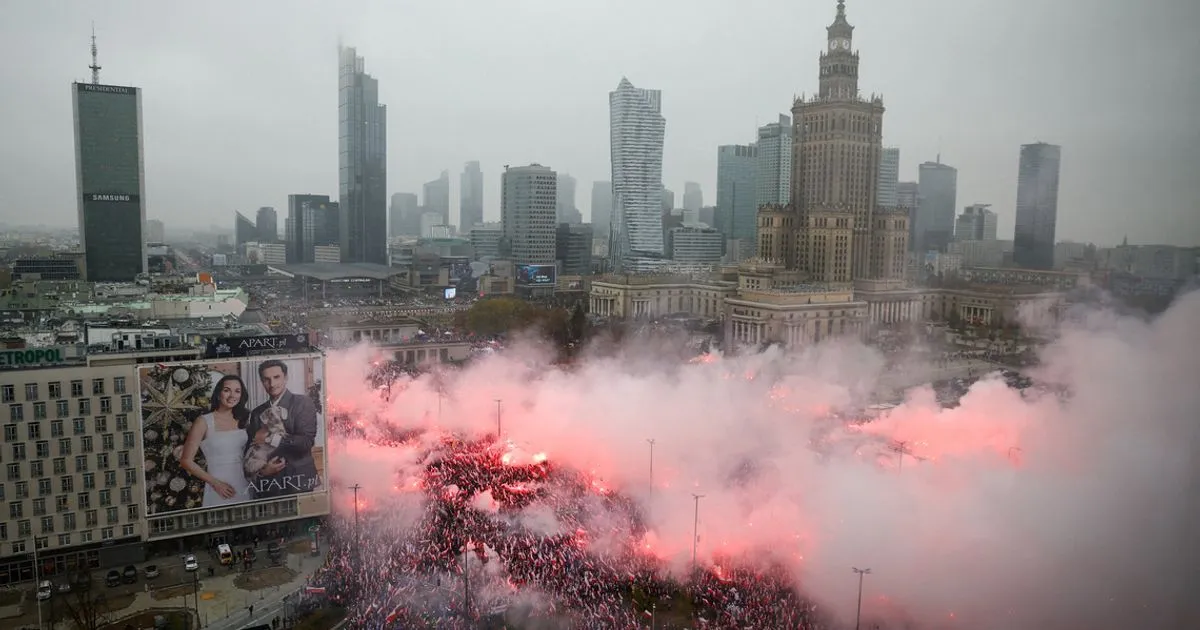
Tens of thousands of supporters of right-wing parties and nationalist organisations gathered in Warsaw for the Independence March on 11 November. President Karol Nawrocki and leaders of opposition parties in the Polish parliament took part.
Security was heightened after the terror attack in central Krakow on 7 November, in which six people were killed. Police said they deployed more officers from outside the capital for the march but declined to give numbers. Concrete barriers were installed on streets adjacent to the downtown starting point, while officers searched nearby areas.

Nawrocki and government camp representatives praised the courage of two policemen, who they said stopped the attacker in a shootout at the risk of their lives. They said the attacker had since died of his injuries. Ministers said the Krakow shooter may have been motivated by far-right ideology, outraging nationalists. Speakers at official events for the anniversary of the independence declaration of 11 November 1918 addressed the attack, which was allegedly carried out by a lone perpetrator.
In his speech, Nawrocki said the reputation of the Polish Constitutional Court had been completely destroyed in recent weeks. He called on the government to rebuild the court together and said the finance minister must do better work. The dispute over the court continued on the national holiday despite appeals for unity.
Prime Minister Donald Tusk responded to the president's speech on X. In a central square, many in the crowd carried large Polish flags under cloudy skies. Polish media reported that chants against Tusk's government came from the crowd.
At least on this one day he could have tried not to divide Poles but to unite them.Wenigstens an diesem einen Tag hätte er versuchen können, die Polen nicht zu teilen, sondern zu verbinden
Prime Minister Donald Tusk
In Szczecin, Tusk appealed for restraint, describing an independent, free and secure Poland as a common good. At an event there, he publicly invited Nawrocki to visit him at home with his family, saying people could talk in the kitchen "like a Pole with a Pole". The formulation came from Solidarnosc leader Lech Walesa during negotiations between the democratic opposition and communist rulers in the 1980s.
Organisers said they expected a record turnout with many foreign nationalists, including Spain's Revuelta youth movement, linked to Vox, and members of Hungary's Mi Hazank party. The escalation of the dispute over staffing the court was one reason for that expectation. In 2025, Warsaw City Administration put attendance at about 100,000, while March Organisers estimated between 250,000 and 300,000.
The march has long caused friction between right-wing parties and ruling centrists, who say it is a platform for racism and antisemitism. Participants deny the allegations and say the gathering is an expression of national pride. Authorities have previously attempted to stop the march after clashes between some participants and political opponents or police.
March organisers urged people not to exploit the march for political ends. Their spokesperson, Rafal Buca, said organisers had condemned political attacks linked to the Krakow shooting from either side.
We want a sovereign Poland, independent of foreign capitals ... We also envision a Poland that is as mono-ethnic as possible
Rafal Buca, spokesperson for the march organisers